 LMPC Registration (Legal Metrology Packaged Commodity)
LMPC Certificate & License in India
LMPC is mandatory because Indian law requires it for anyone who manufactures, packs, sells, or imports pre‑packaged commodities, to protect consumers and ensure fair trade in weights, measures, and labeling.
 Legal Metrology Registration Certificates, commonly called a Legal Metrology Packaged Commodity (LMPC) certificate. An LMPC certificate is an import requirement under the Legal Metrology Act, 2009, and Section 27 in The Legal Metrology Act, 2009, Legal Metrology (Packaged Commodity) Rules, 2011. The Act governs trade in goods that are sold or distributed by weight, measure or number. By defining strict rules and regulations, including for pre-packaged goods, the Act seeks to promote fair trade practices and protect consumer rights.
1. Registration and Licensing: Manufacturers, packers, and importers of packaged commodities are required to obtain registration or a license from the respective legal metrology authorities, such as the Controller or Director of Legal Metrology.
2. Compliance and Enforcement: The Legal Metrology Act and the Packaged Commodities Rules provide for enforcement mechanisms, including inspections, seizure of non-compliant goods, and penalties for violations, to ensure compliance with the regulations.

The Legal Metrology Act, 2009 (LM Act) plays an important role in ensuring fairness and transparency in trade by standardizing weights, measures, and pre-packaged commodities. 
Since a large portion of commerce in India involves goods that are either pre-packed or sold using weighing and measuring instruments,
The Act mandates that businesses obtain the necessary registrations or licences depending on their role. Importers, manufacturers, and packers must register under the Legal Metrology (Packaged Commodities) Rules, 2011, while manufacturers, repairers, and dealers of weights and measures require state licences. Retailers and e-commerce sellers, though not always required to register, must ensure they sell only compliant products.
Non-compliance with the provisions of the Act can have serious consequences. Goods may be seized, businesses may face substantial fines, and repeat offenders may even face prosecution or imprisonment. Thus, compliance with Legal Metrology is not merely a legal requirement but also a vital step in building consumer trust, maintaining market credibility, and avoiding costly penalties.
- What Are Pre-packaged Goods?

- Pre-packaged goods are packed and sealed before becoming available to the masses. As a consumer, you are not able to test the flavour, aroma or any other property of such commodities. The interesting aspect of such products is that the chances of manipulating the quantity are zero. However, not much can be said about such products adhering to the laws that regulate packaging.

- The number of consuming foods that are defined as pre-packaged goods is innumerable. Some of these include dried fruits, soups, dried vegetables, energy drinks, energy bars, breakfast cereals, frozen meals, flavoured yoghurt varieties, canned jams and butter, and fruit cocktails, among numerous others. Products like cement, chemical wires, wool, paint, as well as refrigerators are defined as pre-packaged goods.
|
|
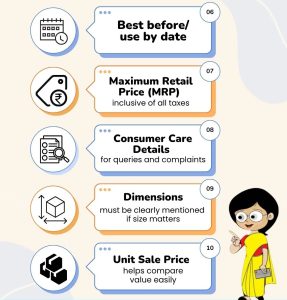
| According to the amendment, the following information has to be displayed in a panel of 40% of the area of the packet in readable font size. |
- Name & Address of the Manufacturer / Packager / Importer
- Net quantity of product (in case of unit for litre, the letter ‘L’ will be used to indicate quantity)
- Manufacturing date of the commodity
- Retail sale price of the commodity
- Dimensions of the commodity if relevant
- Consumer care contact no.
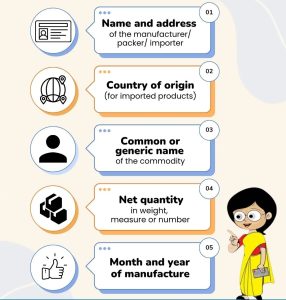
It is mandatory to ensure a number of Declarations Details like:
- Name and address of the manufacturer/packer/importer, the country of origin
- Common or generic name of the commodity
- Net quantity, the month and year of manufacture
- Best used before – the date should be stated for consumers to understand the shelf-life of the product.
- Date of import
- Name of the country to which the products are native
- Maximum Retail Price (MRP) and consumer care information.

|
List of Documents LMPC-PCR
|
FAQ About LMPC Guidelines |
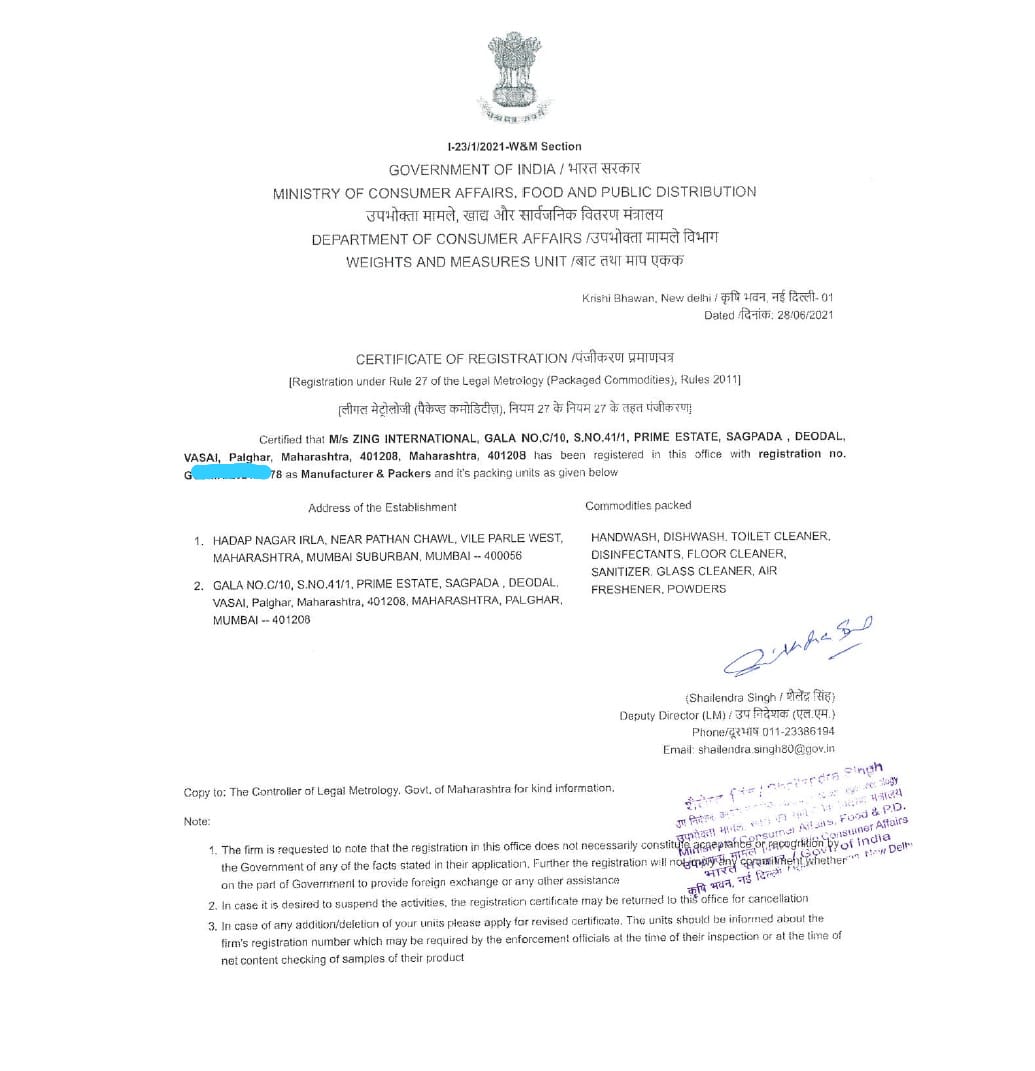
LMPC Sample Certificate Section 19
|



How to get LMPC Certificate?
Applications is based on online. There are a number of Indian states which assist in this registration at a state level. In case of non-availability of online services, you can file your application in person at the legal metrology department in your city.
You can also take recourse to paid legal advice and allow the concerned person to complete the necessary formalities for you. There are many officials who assist individuals in these matters and help in filing the application.
-
Legal Metrology (LMPC) Registration Services – Equal Consultancy Services Provide Fast, Hassle‑Free Approval for Pre‑Packaged Products
| What Are an Importer’s, Producer and Packers Responsibility? |
- The responsibilities of importers are as follows: Submit all details – name and address of the importer
- Furnish details of the manufacturer of the product Quantity, Unit etc.
- State country of origin Name mentioned
- Mention the generic name of the product
- State the exact quantity of the product
- Mention the correct date of manufacture – date, month, and year
- Mention the month and year of importing the product
- State the correct price of the product – maximum retail price
- Mention details like dimensions or capacity wherever required
The Legal Metrology Act, 2009 encompasses a wide range of provisions that govern various aspects of measurement standards and practices by mandating the use of verified and calibrated weighing and measuring instruments, protecting the consumers from malpractices and transparent trading. Moreover, it is vital to raise awareness about the Act and its implications.
 |
 |
 |
 |