

1. What is EPR Battery Registration in India?
The Ministry of Environment, Forest and Climate Change (MoEFCC) notified the landmark Battery Waste Management Rules (BWMR), 2022, superseding the erstwhile Batteries (Management and Handling) Rules, 2001. Under these updated guidelines, Extended Producer Responsibility (EPR) is a statutory mandate holding producers, importers, and brand owners accountable for the entire lifecycle of batteries introduced into the Indian market.
EPR Battery Registration requires enterprises to obtain formal authorization from the Central Pollution Control Board (CPCB) via its centralized online portal. The objective is to establish an organized collection, refurbishment, and recycling infrastructure to prevent hazardous materials (such as lithium, cadmium, lead, and nickel) from contaminating soil and groundwater.
2. Who is Required to Obtain Battery EPR Registration?
Under Rule 4 of BWMR 2022, no entity can manufacture, import, assemble, or distribute batteries without registering on the centralized CPCB online portal. The regulatory categories include:
Producers & Manufacturers
Domestic manufacturers producing lead-acid, lithium-ion, alkaline, or nickel-based batteries for consumer, industrial, or automotive applications.
Battery Importers
Any business importing raw cells, battery packs, or standalone batteries into Indian customs territory for retail sale or commercial distribution.
Equipment & OEM Importers
Enterprises importing products with pre-installed or bundled batteries (e.g., Electric Vehicles, laptops, smartphones, power tools, UPS systems).
Recyclers & Refurbishers
Facilities authorized by State Pollution Control Boards (SPCBs/PCCs) dedicated to dismantling, metal recovery, or extending battery service life.
3. Categories of Batteries Covered Under BWMR 2022
The rules encompass four distinct operational battery classifications across all chemical formulations:
| Battery Category | Common Applications | Dominant Chemistries |
|---|---|---|
| Electric Vehicle (EV) Battery | 2W, 3W, 4W EVs, Commercial Electric Buses, Heavy Fleet | Lithium Iron Phosphate (LFP), NMC, Solid-state |
| Portable Battery | Laptops, smartphones, smartwatches, household appliances | Lithium-Cobalt, Alkaline, Nickel-Metal Hydride (NiMH) |
| Automotive Battery | Starting, Lighting, and Ignition (SLI) in ICE vehicles | Flooded Lead-Acid, Valve Regulated Lead-Acid (VRLA), AGM |
| Industrial Battery | Telecom towers, grid storage, data centers, UPS systems | Lead-Acid, Lithium-Ion, Nickel-Cadmium (Ni-Cd) |
4. Step-by-Step CPCB Portal Registration Process
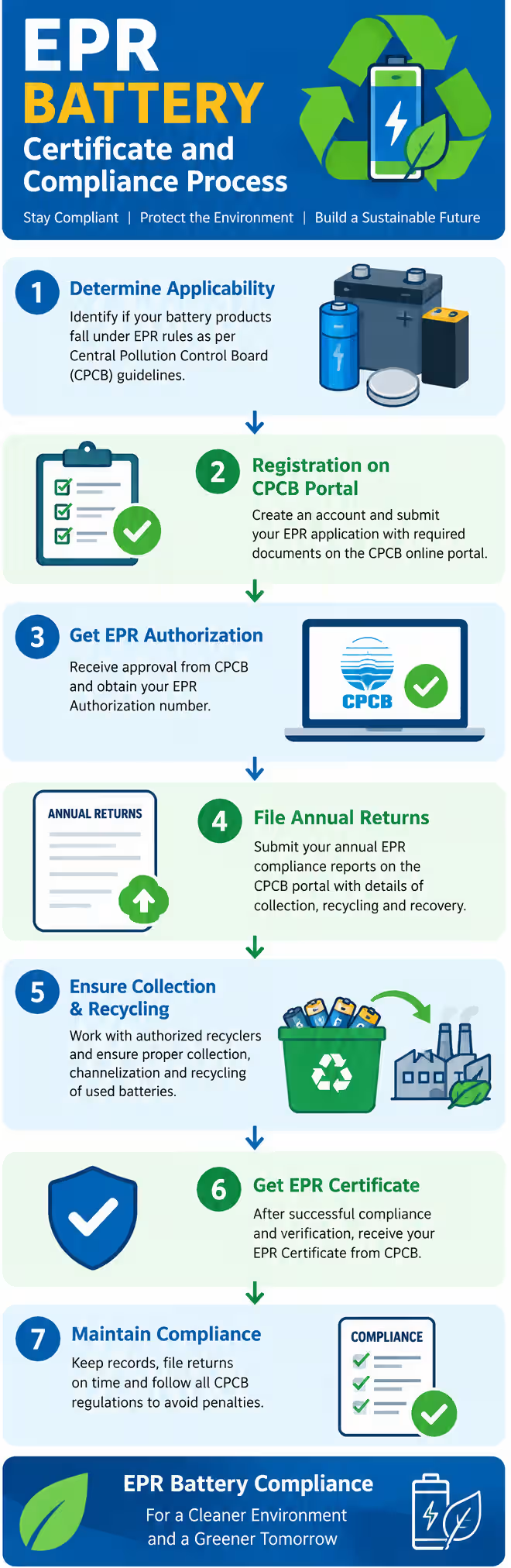
The registration process is administered digitally via the official CPCB portal (eprbatterycpcb.in). Follow this structured 5-step roadmap:
Determine whether you qualify as a Producer, Importer, or Recycler. Ensure all corporate licenses (PAN, CIN, GST, IEC) and technical battery chemistry specifications are prepared and verified.
Create an enterprise profile on the CPCB portal. Register the authorized representative via digital verification, Aadhaar OTP, and authorized company board resolution.
Log in to the dashboard and complete the comprehensive application:
- Details of battery types, models, weights, and chemical breakdown.
- Historical production or import volumes for the preceding two financial years.
- Projected sales forecast for the upcoming financial year.
- EPR plan outlining reverse logistics, buy-back networks, or tie-ups with certified recyclers.
Remit the prescribed non-refundable CPCB application processing fees based on your annual tonnage volume via the integrated payment gateway. CPCB scrutiny officers verify the submitted dossier.
Upon addressing any raised clarifications (requisitions), CPCB issues the official EPR Registration Certificate with a unique EPR Battery Registration Number.
5. Mandatory Documents Checklist for CPCB Registration
Having accurate documentation prevents portal rejections. Prepare the following records:
Statutory Corporate Documents
- Company Incorporation Certificate (CIN) / Partnership Deed
- Company PAN Card & GST Registration Certificate
- Import Export Code (IEC) certificate (Mandatory for Importers)
- Authorized Signatory ID proof & Board Resolution / Letter of Authorization
Technical & Operational Data
- Technical specification datasheets & MSDS of batteries
- HSN code mapping & annual volume/weight breakdown (Kg/MT)
- Consent to Establish (CTE) & Consent to Operate (CTO) (For domestic plants)
- Agreements with registered recyclers or refurbishers
6. Battery EPR Targets & Recycling Obligations
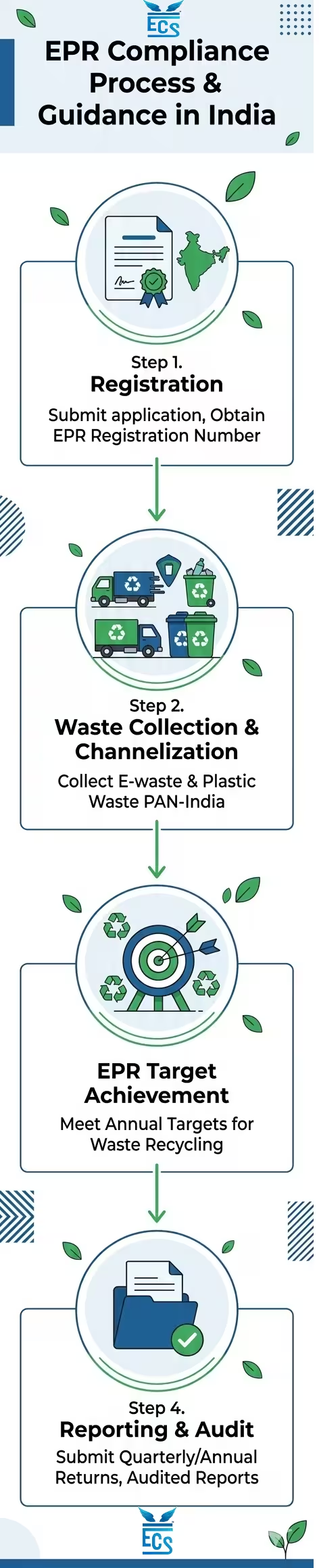
Obtaining the CPCB certificate is only the first step. Registered producers and importers must fulfill progressive Mandatory Collection and Recycling Targets.
Under BWMR 2022, collection targets are calculated as a percentage of the average weight of batteries placed in the market in prior years. Crucially, recycling targets include not just overall weight, but specific material recovery standards (e.g., minimum percentage recovery targets for Cobalt, Nickel, Lithium, and Lead).
EPR Certificates & Trading: Producers meet their statutory obligations by acquiring digital EPR credits from certified recyclers registered on the CPCB portal. Surplus credits can be banked or transferred, making accurate registry maintenance essential.
Confused by CPCB Battery EPR Portal Guidelines?
Equal Consultancy simplifies complex environmental regulations. We manage end-to-end documentation, portal filing, credit fulfillment, and annual reporting for producers, EV companies, and importers.
Book Your Free EPR Consultation7. Penalties for Non-Compliance under BWMR 2022
Operating without a valid CPCB Battery EPR certificate carries strict regulatory penalties:
- Customs Consignment Holds: Importers without valid CPCB EPR numbers face port clearance holds and detention charges.
- Environmental Compensation (EC): CPCB imposes heavy financial penalties on a "polluter pays" basis for delays or missed recycling targets.
- Revocation of Trade Authorization: Persistent non-compliance can lead to the cancellation of CTOs and blacklisting from the national EPR portal.
8. Why Partner with Equal Consultancy?
Equal Consultancy is India's premier regulatory and environmental compliance partner, helping businesses navigate MoEFCC, CPCB, and SPCB frameworks.
Turnkey Portal Management
From initial dossier curation to CPCB portal application submission and liaison, our experts manage the complete lifecycle with guaranteed turnaround times.
Verified EPR Credit Procurement
We connect producers with a verified network of authorized recyclers across India, securing genuine EPR certificates for seamless target compliance.
Post-Registration Compliance
We handle quarterly data filings, annual returns, reconciliation audits, and ongoing compliance advisory to protect your business from penalties.
Industry-Wide Expertise
Trusted by EV manufacturers, consumer electronics importers, telecom infrastructure providers, and industrial battery suppliers nationwide.
9. Frequently Asked Questions (FAQs)
What is the validity period of the CPCB Battery EPR Certificate?
The CPCB Battery EPR registration certificate is usually granted for a period of 5 years. It requires timely filing of annual returns and continuous adherence to yearly collection and recycling targets.
Is EPR registration required if we import EV vehicles with built-in batteries?
Yes. Any business or OEM importing equipment or vehicles containing pre-installed batteries must register as an importer under BWMR 2022 and fulfill corresponding EPR recycling quotas.
What are EPR Certificates (Credits) on the CPCB portal?
EPR Certificates are digital credits generated when registered recyclers recycle end-of-life batteries. Producers and importers purchase these credits through the CPCB centralized system to offset and prove their annual recycling targets.
How long does it take to obtain the CPCB Battery EPR Registration?
With accurate documentation and expert handling by Equal Consultancy, standard CPCB portal approval typically takes between 15 to 30 working days from the date of submission.