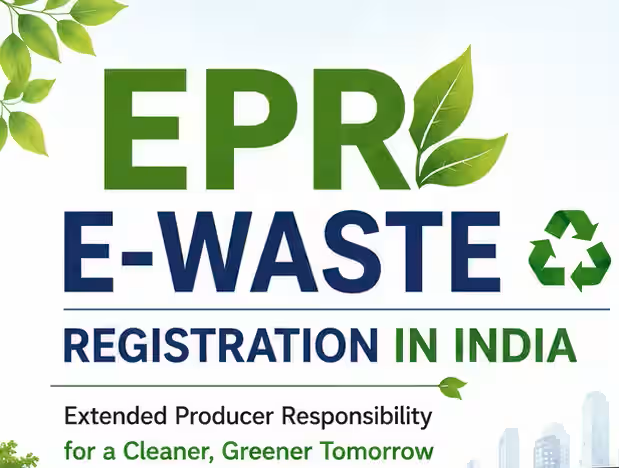
What is EPR E-Waste Registration in Mumbai?
Extended Producer Responsibility (EPR) for E-Waste is a statutory environmental governance mandate promulgated by the Ministry of Environment, Forest and Climate Change (MoEFCC) and enforced through the Central Pollution Control Board (CPCB) and Maharashtra Pollution Control Board (MPCB). Under the E-Waste (Management) Rules, any business entity producing, importing, or commercializing electrical and electronic equipment (EEE) in Mumbai is legally accountable for the environmentally sound channelization, dismantling, and certified recycling of end-of-life electronic goods.
An official CPCB EPR E-Waste Certificate is an uncompromising customs clearance credential. Indian Customs at JNPT (Nhava Sheva) Port and Mumbai Air Cargo Complex will not grant Out of Charge (OOC) release for imported commercial electronics consignments until an active, verified CPCB EPR registration number is populated and authenticated on the Bill of Entry via the ICEGATE EDI system. Operating without this certification triggers immediate show-cause notices, environmental compensation fines, and port demurrage charges.
Applicable Schedule-I EEE Categories in Mumbai
Our Mumbai environmental law and technical advisory team handles end-to-end portal compliance, credit trading, and audit defense across all notified Schedule-I electrical and electronic equipment categories.
Mandatory certification for manufacturers and importers covering 29+ notified item codes including centralized data servers, mainframes, laptops, personal computers, modems, routers, mobile phones, and cordless handsets.
- Historical sales quantity calculation & end-of-life target allocation
- RoHS (Restriction of Hazardous Substances) lab testing compliance
- Procurement of verified CPCB portal recycling credits
- Customs clearance bond and Bill of Entry reconciliation at JNPT
Explore IT & Telecom EPR Services →
Enforced under E-Waste Rules across consumer devices including television sets (LED, LCD, OLED), refrigerators, washing machines, air conditioners, audio systems, and digital display signage.
- Producer, Importer & Recycler registration on CPCB portal
- Product weight calculation and target obligation models
- Collection channelization and PRO agreement integration
- Annual Form-2 compliance and MPCB state liaison
Explore Consumer Electronics EPR →
Statutory coverage for microwaves, electric fans, vacuum cleaners, smart home electrical gadgets, water heaters, and coffee dispensers commercialized across Maharashtra.
- HSN code mapping and weight determination audits
- Online portal application filing with statutory treasury fees
- E-waste credit trade execution with certified dismantling hubs
- Customs Bill of Entry endorsement for swift cargo clearance
Explore Household Appliances EPR →
Mandatory authorization for diagnostic imaging instruments, automated laboratory analyzers, electronic industrial tools, controllers, monitoring units, and surveillance systems.
- Customs clearance assistance for specialized high-value medical imports
- Coordination with NABL-accredited labs for RoHS hazardous screening
- Annual environmental returns and CPCB audit-readiness defense
- Authorized dismantler agreements and online certificate registry
Explore Industrial & Medical Electronics →
E-Waste EPR Recycling Targets & Statutory Trajectory
Under the CPCB E-Waste Management framework, producers and importers face legally binding annual recycling targets based on the average lifespan of notified EEE items. Review the statutory trajectory below:
| Financial Year | Statutory Recycling Target | Core Producer Obligation | Target Verification Mode |
|---|
| FY 2023–2024 | 60% of sales volume based on lifespan | Collection, channelization & recycling certificate purchase | CPCB Portal Online Credit Certificates |
| FY 2024–2025 | 70% of sales volume based on lifespan | Mandatory recycling credit reconciliation & Form-2 filing | Authorized Recycler Electronic Ledger |
| FY 2025–2026 | 70% of sales volume based on lifespan | End-of-life electronics verification & non-ferrous recovery | CPCB Centralized Credit Transfer Portal |
| FY 2026–2027 Onwards | 80% of sales volume based on lifespan | Full circular economy compliance & annual audit verification | Registered Recycler Certificate Exchanges |
Documents Required for CPCB EPR E-Waste Registration in Mumbai
Compile the following statutory legal and technical documents to enable our regulatory specialists to prepare and file your CPCB portal dossier within 48 hours:
| Document Type | Description / Specification | Issuing Authority |
|---|
| Company Constitution | Certificate of Incorporation (CIN), MOA/AOA, Partnership Deed, or MSME / Udyam registration. | MCA / MSME |
| GSTIN Certificate | Active Maharashtra GST registration reflecting registered corporate office and warehouse locations. | GST Department |
| Import Export Code (IEC) | Mandatory DGFT IEC certificate for all importers clearing consignments at JNPT or BOM Air Cargo. | DGFT India |
| Signatory Authorization | Board Resolution / Power of Attorney along with PAN and Aadhaar proof of the designated director. | Company Board |
| RoHS Compliance Proof | Declaration or NABL laboratory test report certifying compliance with hazardous substance limits. | OEM / Accredited Lab |
| Product & HSN Breakdown | Itemized EEE categories with corresponding HSN codes, model numbers, and technical datasheets. | Equal Consultancy (Drafted) |
| Historical Sales & Import Invoices | Year-wise procurement, production, or Bill of Entry quantity records for the preceding financial years. | Corporate Accounts |
Step-by-Step CPCB EPR E-Waste Registration Process in Mumbai
Equal Consultancy Services executes a streamlined, audit-proof workflow directly through the central CPCB portal:
1Applicability & EEE Audit
We audit your product catalog against Schedule-I notified codes, determine lifespan, and compute targets.
2Dossier & RoHS Compilation
Drafting statutory undertakings, RoHS compliance affidavits, and compiling business registration records.
3CPCB Portal Filing
Submitting the formal application on the central digital e-waste portal with statutory departmental fee processing.
4Query Resolution & Scrutiny
Direct technical representation before CPCB officers to address review observations without delays.
55-Year Certificate Issuance
Grant of the official 5-year valid CPCB EPR Certificate and immediate ICEGATE customs port synchronization.
6Credit Fulfillment & Returns
Procuring verified recycling credits from accredited recyclers and submitting annual Form-2/3 returns.
EPR E-Waste Compliance Resource Centre
Download verified checklists, statutory regulations, application guidelines, and official circulars directly in PDF format.
E-Waste Documents Checklist
Complete documentation checklist for IT, telecom, and consumer electronics registration on CPCB portal.
CPCB E-Waste Rules FAQ Guide
Official regulatory FAQ guide clarifying producer classifications, recycling targets, and penalty waivers.
CPCB Portal Registration Manual
Illustrated walkthrough for profile setup, Schedule-I entry, portal document uploading, and fees payment.
Schedule-I Item Code List
Detailed classification sheet of all notified EEE product codes (ITEW, CEEW, LHEW) for precise customs filing.
Regional EPR E-Waste Coverage Across Mumbai & Maharashtra
Equal Consultancy Services provides local on-site audits, port clearance support, and MPCB regional office liaison across key industrial belts:
JNPT Nhava Sheva & Ports
Direct port customs coordination, container freight stations (CFS), and maritime import release at Nhava Sheva.
Mumbai Air Cargo & Suburban
Air Cargo Complex Sahar (BOM), Andheri East MIDC, Kanjurmarg, Marol, and Western suburban trading districts.
Navi Mumbai Industrial Belt
TTC Industrial Area, Mahape Millennium Business Park, Turbhe, Rabale, Pawane, and Taloja chemical MIDC.
Thane & Logistics Corridors
Wagle Industrial Estate, Ghodbunder Road, Bhiwandi e-commerce warehousing clusters, and Kalyan-Dombivli belt.
Palghar & Tarapur MIDC
Tarapur Industrial Zone, Boisar manufacturing belt, Vasai-Virar electronics engineering, and Daman border trade corridor.
Pune & Chakan Industrial Hub
Pimpri-Chinchwad (PCMC), Chakan MIDC, Talegaon, Ranjangaon, and Hadapsar manufacturing corridors.
Frequently Asked Questions — EPR E-Waste Mumbai
What is EPR E-Waste Registration under CPCB in Mumbai?
EPR (Extended Producer Responsibility) E-Waste Registration is a mandatory statutory authorization issued by the Central Pollution Control Board (CPCB) under the E-Waste (Management) Rules. It establishes legal accountability for producers, importers, and brand owners to collect, channelize, and finance the scientific recycling of end-of-life electronics.
Why is EPR authorization mandatory for Customs clearance at JNPT and Mumbai Air Cargo?
Indian Customs at JNPT (Nhava Sheva) and Air Cargo Complex Sahar strictly mandate an active CPCB EPR registration number on the Bill of Entry via ICEGATE. Consignments containing notified electrical and electronic goods cannot be granted Out of Charge (OOC) release without this authorization.
What is the validity period of a CPCB EPR E-Waste Certificate?
A standard CPCB EPR Registration Certificate is granted with a validity of five (5) years, subject to annual environmental compliance reporting, recycling target fulfillment, and filing mandatory Form-2 annual returns on the central portal.
How are EPR recycling obligations fulfilled online?
Producers satisfy their statutory recycling obligations by purchasing certified EPR recycling credits generated by registered electronic waste recyclers on the central CPCB portal. Equal Consultancy Services assists with target computation and legitimate credit transfer coordination.
How long does it take to obtain CPCB EPR E-Waste Approval in Mumbai?
With Equal Consultancy Services, complete documentation is compiled and verified within 24 to 48 hours, and official CPCB portal filing is processed rapidly, reducing the overall certificate issuance turnaround to 10–14 working days.
Fast-Track Your CPCB EPR E-Waste Approval in Mumbai
Prevent customs port holds at JNPT, eliminate non-compliance penalties under the Environment Protection Act, and secure compliant recycling credits.